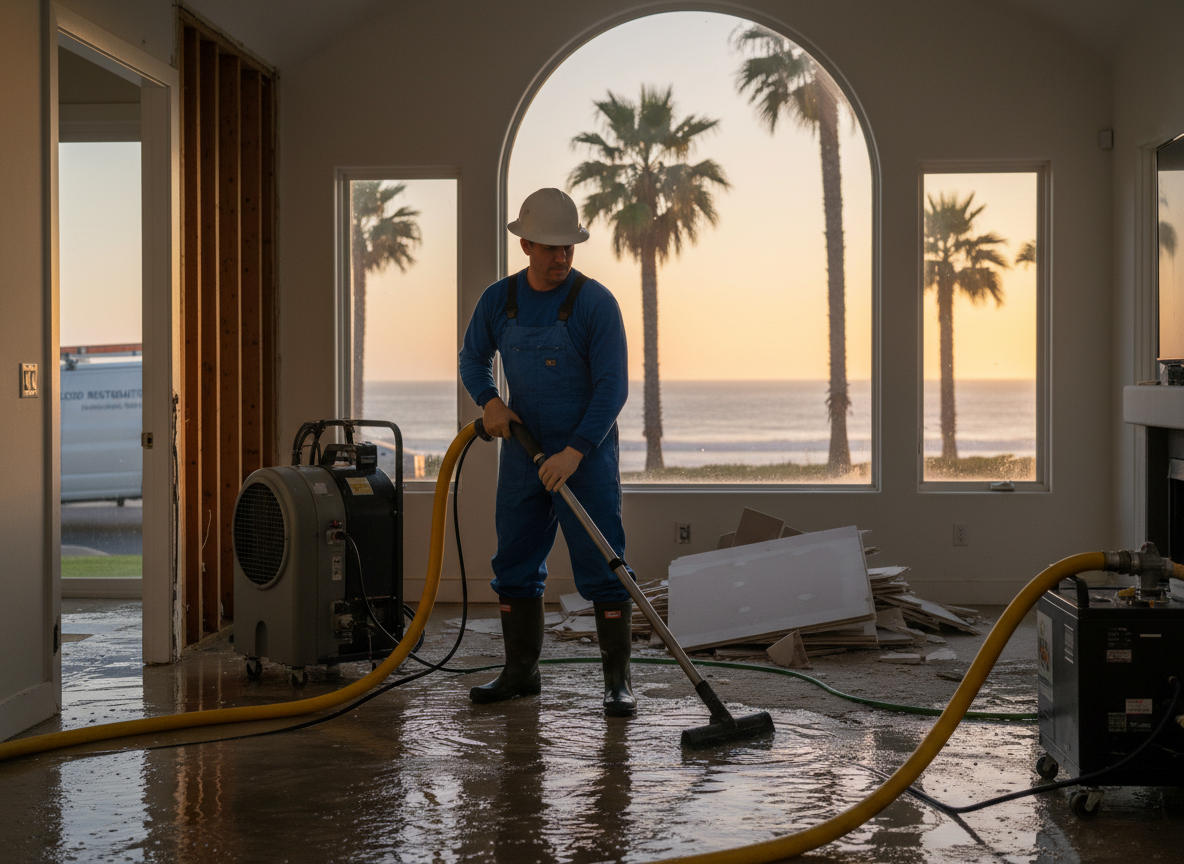
Solana Beach sits under a mild coastal Mediterranean climate where winter storms and occasional San Elijo Lagoon surges push water into homes along Lomas Santa Fe Drive and the Coastal Rail Trail corridor. Flood restoration here often involves saltwater intrusion that accelerates corrosion in electrical systems and leaves behind chlorides that standard freshwater drying methods miss. Older single-story ranch homes in Solana Highlands and Downtown commonly have slab-on-grade construction with limited access points, so extraction crews must cut strategic relief holes to reach trapped water beneath tile or hardwood without triggering mold in the coastal humidity.
When water crosses from the lagoon or Fletcher Cove Park drainage into residential yards, sediment loads are higher than typical inland floods because of the sandy coastal soil. Technicians remove and dispose of contaminated baseboard and insulation on the first visit, then run industrial air movers and dehumidifiers calibrated for ocean air moisture. San Diego County building codes require documentation of moisture readings at multiple depths in walls before drywall can be replaced, especially in homes near the rail trail where groundwater tables sit close to the surface.
Nearby Encinitas and Del Mar share the same coastal exposure, so crews keep portable generators and extra desiccant units staged at the 911 Lomas Santa Fe Drive location for rapid deployment when Pacific storms coincide with high tide. Homeowners in these neighborhoods frequently discover hidden damage weeks later in HVAC returns or under kitchen cabinets because initial water traveled laterally through stucco weep holes rather than pooling visibly on floors.
Technician insight
In Solana Beach, the thing that catches most people out with Flood restoration services is how quickly ocean-influenced humidity re-wets walls after initial extraction, especially in Lomas Santa Fe homes built on the slight slope toward the lagoon. Homeowners often stop drying too soon because the floor feels dry while the lower six inches of drywall stay damp from capillary wicking through sandy soil.
Lagoon surge into Lomas Santa Fe home
Winter storm pushed San Elijo Lagoon water across yards and under a single-story home near the rail trail. Extraction revealed trapped water beneath the slab edge that had wicked into perimeter framing. Crews cut access points, dried the cavity for six days, and replaced affected baseboard and insulation while keeping the family in the undamaged half of the house.
How it works
- 1
Emergency Assessment
Technician arrives within hours, maps water migration paths through the property, and records moisture levels in walls, floors, and subflooring.
- 2
Water Extraction
High-capacity pumps and wands remove standing water, followed by targeted drying of slab edges and wall cavities common in local ranch-style homes.
- 3
Drying and Monitoring
Industrial equipment runs continuously with daily moisture readings logged until levels match unaffected materials in the same coastal climate.
- 4
Sanitizing and Restoration
Antimicrobial treatment addresses lagoon or ocean sediment, then damaged drywall, baseboards, and flooring are replaced to code.
Pricing
Scope and duration determine final cost; every job receives an upfront written quote before work begins.